Septic Installation Checklist for New Homeowners in Stockbridge, GA
New homeowners in Stockbridge, GA can avoid costly surprises by following a clear septic installation checklist before, during, and after the project.
What Should Be on Your Pre-Installation Checklist?
Before any equipment arrives at your property, several important steps need to happen in the right order. Skipping any one of them can stall your project, delay permits, or result in a system that doesn't meet Georgia's code requirements.
First on your list should be a site evaluation and soil test. A licensed contractor will visit your property to assess lot size, topography, proximity to wells and property lines, and the presence of any drainage issues that could affect system placement. The soil test — sometimes called a perc test — measures how quickly your soil absorbs water. This result directly determines what type of system you can install and how large your drain field needs to be.
Second, confirm your setback requirements with Henry County's health department. Georgia law requires minimum distances between your septic system and structures, property lines, wells, and bodies of water. These setbacks vary by system type and county. Getting clarity on these numbers before finalizing your system design prevents surprises during the permit review process.
Third, make sure your contractor is licensed by the State of Georgia to design and install on-site sewage management systems. Unlicensed work can result in failed inspections, permit revocations, and costly do-overs. Ask to see credentials before any agreements are signed. See how septic installation and other services are delivered across the area on our areas we serve page.
Does Stockbridge's Terrain Shape How Your System Gets Designed?
Stockbridge and the surrounding Henry County landscape present a specific set of conditions that directly influence how your septic system gets designed. Understanding those conditions helps you have more informed conversations with your contractor and set realistic expectations for the project.
Henry County sits in the upper Piedmont region of Georgia, where the terrain tends to involve rolling hills, gentle slopes, and soil with significant clay content. Sloped land can actually work in your favor — it allows gravity-fed drain field systems that don't require a pump — but the slope must fall within specific ranges to be usable. Steeper grades may require engineered solutions and more complex permit documentation.
The clay-heavy soil common throughout Stockbridge absorbs water more slowly than sandy soil, which means drain fields in this area typically need to be larger. Your system designer will calculate the minimum drain field size based on your perc test results and household size. Trying to reduce the drain field size to save money upfront often leads to early failure and a much larger expense later.
Properties near Henry County's creek systems and lower-lying areas may have higher water tables, which can restrict where a conventional drain field can be placed. In these situations, a mound system or alternative system type may be required. Your soil evaluation will identify these conditions, and your contractor should explain all options clearly before the design is finalized.
What Happens During Installation and Inspection?
Once permits are approved, installation follows a defined sequence that most homeowners aren't familiar with until they're in the middle of it. Knowing what to expect makes the process less stressful and helps you verify that work is proceeding correctly.
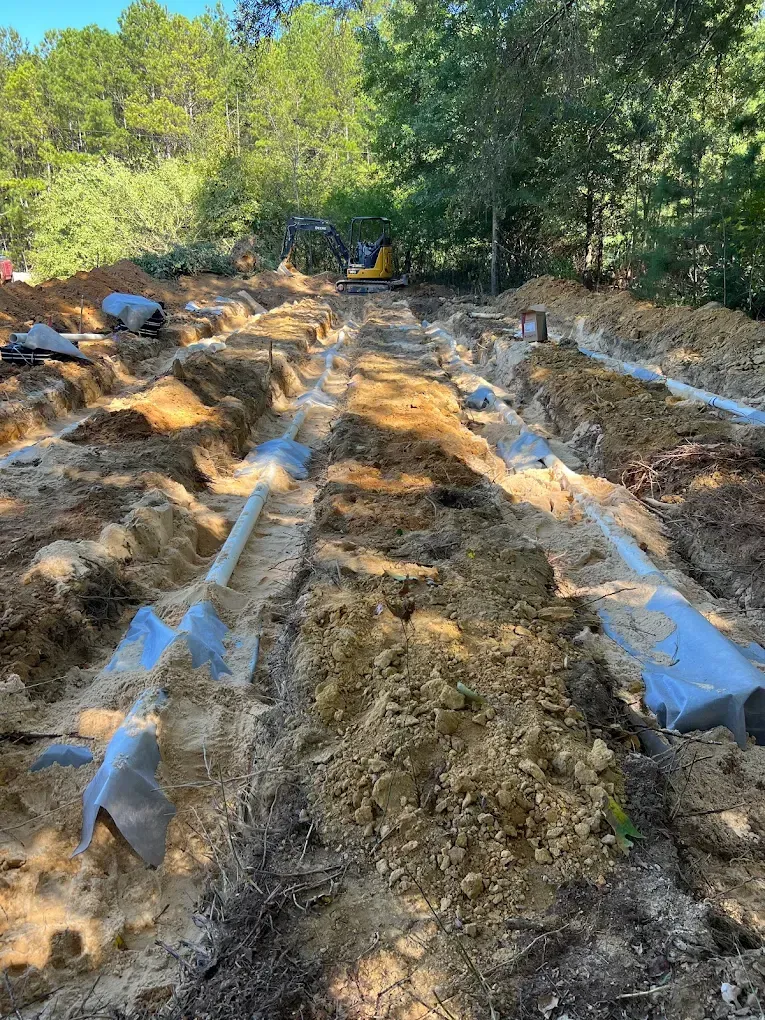
Excavation comes first. Your contractor digs the trench for the tank, positions the concrete or fiberglass tank in the excavated area, and connects inlet and outlet pipes. The drain field is excavated separately, and distribution pipes or chambers are placed at the correct depth and spacing according to the approved design. Proper grading around the drain field ensures rainwater flows away from the absorption area rather than toward it.
Once installation is complete, you'll need a final inspection from the county health department before the system can be covered and placed into service. This inspection confirms that the actual installation matches the approved design — correct depth, setbacks, component placement, and grading. If anything doesn't match, corrections must be made before the inspection passes and the system is cleared for use.
After passing inspection, your contractor should walk you through the system's components, maintenance schedule, and any signs of trouble to watch for. A new system typically requires pumping every three to five years depending on household size and usage patterns.
How Has Stockbridge's Growth Affected New Septic Installations?
Stockbridge has grown steadily over the past two decades, and that growth has had a direct effect on the residential septic landscape. Understanding the local development context helps you see why careful system planning matters more now than it did for properties installed 20 or 30 years ago.
As new subdivisions expand outward from established Stockbridge neighborhoods, many new construction lots are on land that was previously agricultural or undeveloped. That land hasn't been tested for septic suitability, and soil conditions can vary significantly even within the same subdivision. What passed a perc test two lots over doesn't guarantee the same results on your parcel.
Increased development also means more competition for licensed contractors, more permit applications at the county health department, and occasionally longer approval timelines during peak building seasons. Starting your soil evaluation and permitting process early — well before you need the system — gives you flexibility and reduces the risk of delays holding up your construction or move-in schedule.
Read firsthand accounts from Stockbridge and Henry County property owners on our customer testimonials page, then call JD Septic & Sewer at (470) 541-0848 to discuss your installation project with someone who knows the area.
A well-planned septic installation protects your Stockbridge property's value and ensures reliable wastewater management for decades. Getting the design, permits, and installation right the first time is always the most cost-effective path.
Connect with JD Septic & Sewer at (470) 541-0848 to start your septic installation services in Stockbridge with an expert team that knows Henry County's terrain and requirements.