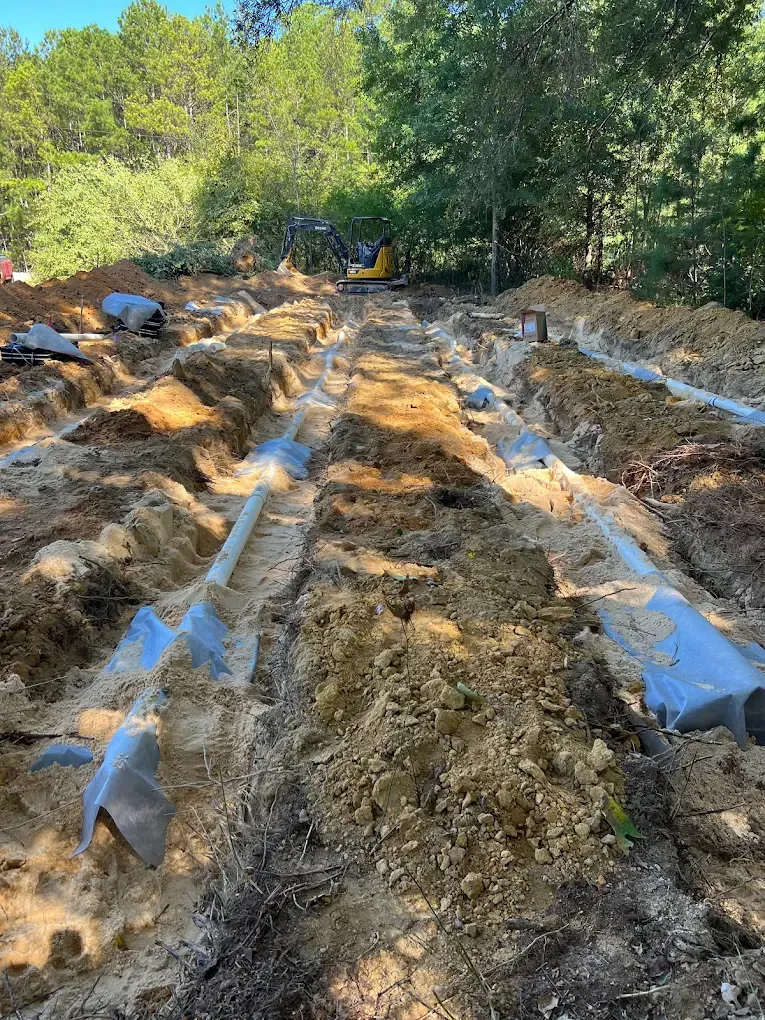
McDonough's Clay Soil Is Already Stressing Your Septic System
What Henry County's Ground Conditions Mean for Repair Timelines
When rainfall saturates the clay-heavy soil beneath McDonough properties, septic drain fields lose their ability to absorb effluent — and that pressure doesn't release when the ground dries out. The damage accumulates with each wet season, compressing soil pores and forcing wastewater back toward the tank rather than away from it. By the time slow drains or yard odors appear, the underlying cause has often been building for months.
JD Septic & Sewer responds to repair calls throughout Henry and Spalding counties, where aging septic infrastructure meets the percolation challenges that Georgia's red clay creates. A cracked baffle lets solids pass directly into the drain field, accelerating the clogging that clay already promotes. A broken distribution line shifts the entire effluent load onto one section of soil, saturating it while the rest of the field sits unused. These failures are diagnosable and correctable — but only if the repair addresses the mechanical cause rather than just the visible symptom.
How Targeted Repairs Restore Function in Clay Soil Conditions
Diagnosing a septic problem in McDonough requires accounting for both the failed component and the soil conditions that accelerated its failure. Camera inspection of distribution lines reveals whether flow is blocked, bypassed, or misdirected. Tank probing identifies baffle deterioration before solids migrate downstream. In clay environments, a repair that restores one component without addressing altered drainage patterns will fail again within the same seasonal cycle.
The team uses targeted excavation to access only what needs correction, minimizing yard disruption while restoring full system function. After repair, visible evidence is clear: drains clear, standing water in the yard dissipates within days, and the tank stops cycling abnormally between pumpings. Every repair is completed to Georgia code standards, with documentation suitable for county health department records or future property transactions.
Don't wait for a minor repair to become a full drain field replacement — contact us now for septic tank repair in McDonough before the next wet season compounds the damage.
Problems That Accelerate in McDonough's Soil Without Prompt Repair
Each of the following failure modes worsens faster in clay-heavy ground because poor percolation leaves no buffer between a component problem and a full system backup:
- Cracked or deteriorated baffles allowing solids to enter and permanently clog McDonough drain fields
- Broken distribution lines concentrating effluent load onto one soil zone until it reaches hydraulic failure
- Root intrusion into inlet or outlet pipes, restricting flow and forcing sewage back into the home
- Failed pump components in pressure-dosed systems, leaving effluent pooled in the tank with nowhere to go
- Collapsed tank lids or sidewall cracks that allow groundwater infiltration, overloading the system during every rain event
In clay soil, a saturated drain field that might recover in sandy ground can take an entire dry season to partially rehabilitate — and may never fully recover without mechanical intervention. Catching these problems at the repair stage rather than the replacement stage is the difference between a one-day fix and a multi-week excavation project. Get in touch today for septic tank repair in McDonough.